

Why Upgrading to a Wearable Silicone Urinary Collector Enhances Patient Comfort and Optimizes Institutional Supply Chain Efficiency
1. The Clinical Reality of Managing Severe Urinary Incontinence in Bedridden Patients
Managing urinary incontinence in long-term bedridden patients remains one of the most resource-intensive challenges in inpatient wards and extended-care facilities. Traditional methods frequently rely on disposable adult diapers, underpads, or indwelling Foley catheters. While indwelling catheters provide precise output monitoring, they carry a notoriously high risk of catheter-associated urinary tract infections (CAUTIs), which extend hospital stays and inflate institutional costs.
Conversely, continuous dependency on heavy absorbent pads creates a highly destructive microenvironment against patient skin. Prolonged exposure to moisture, combined with the chemical irritants in urine like ammonia, quickly breaks down the acid mantle of the skin. This breakdown leads directly to incontinence-associated dermatitis (IAD) and exponentially increases the vulnerability of the sacral region to pressure injuries.
To break this cycle, modern clinical frameworks emphasize non-invasive urinary collection systems that isolate moisture from the patient’s body immediately upon excretion. Transitioning to advanced external collection devices helps clinical teams preserve skin integrity while avoiding the invasive risks associated with internal catheterization.
2. Biocompatibility and Mucosal Safety of Medical-Grade Silicone Materials
When selecting non-invasive urinary management devices, material composition dictates both patient compliance and clinical safety. Traditional external collection systems often utilized latex or rigid plastics, which frequently triggered contact allergies, localized inflammation, or friction injuries along sensitive inguinal and perineal skin tissues.
Integrating medical-grade silicone in modern collection devices represents a significant upgrade in mucosal safety and mechanical biocompatibility. Pure silicone is inherently hypoallergenic, chemically inert, and lacks the volatile organic compounds often found in cheaper plastics. Its hydrophobic surface prevents the accumulation of cellular debris and crystalline urine deposits, which are common breeding grounds for bacterial biofilms.
Furthermore, the mechanical elasticity of soft silicone allows the device’s collection chamber to contour seamlessly to varying patient anatomy without exerting excessive localized pressure. By distributing structural tension evenly, the material avoids micro-tears in the epidermal layer. This level of tissue protection is especially vital for geriatric patients whose skin layers have naturally thinned and lost structural collagen over years of aging.
3. Analyzing the Biomechanical Performance of Leak-Proof Structural Engineering
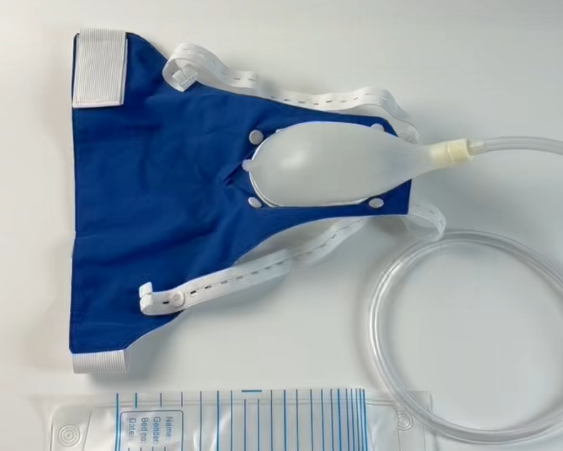
An external urinary device is only as effective as its physical containment capability. Standard external sheaths or pouch systems frequently fail during patient repositioning, resulting in catastrophic leaks that soil bed linens and contaminate adjacent wound dressings. Advanced wearable collectors counteract this vulnerability through a multi-tiered structural design that includes a form-fitting silicone containment cup, adjustable stabilization straps, and reinforced lateral fastening buckles.
The primary containment chamber relies on a secure yet flexible seal that adapts dynamically as the patient rolls or shifts position in bed. This anatomical adaptation prevents fluid from tracking backward along the perineum. Working in tandem with the flexible chamber, wide-set lateral straps distribute structural tension across the hips rather than concentrating stress on the groin.
By stabilizing the collection funnel firmly over the urethral meatus, the integrated fastening system maintains an uninterrupted fluid pathway. This structural integrity remains constant even when patients experience involuntary muscle spasms or require frequent mechanical turning by the nursing staff to prevent pressure ulcers.
4. The Fluid Dynamics of Anti-Reflux Drainage and Effective Infection Control
Fluid statics and dynamics play a critical role in preventing ascending urinary tract colonization. When a patient is restricted to a horizontal supine position, the risk of urine backflow from the storage bag toward the urethral orifice rises substantially, particularly during physical transport or turning protocols.
To mitigate this risk, modern external collection setups incorporate specialized anti-reflux medical urine bags into the fluid line. These bags feature one-way mechanical valves that allow urine to pass freely into the reservoir under minimal gravitational pressure while preventing fluid from surging backward when the bag is squeezed or elevated.
At the base of the reservoir, quick-release drainage valves allow caregivers to empty accumulated fluids smoothly without introducing turbulent airflow or aerosolizing pathogens into the patient’s immediate environment. By maintaining an isolated, unidirectional fluid pathway, this design actively disrupts the migration of uropathogens, protecting the patient’s lower urinary tract without requiring systemic prophylactic antibiotics.
5. Reducing Caregiver Burden and Enhancing Ward Workflow Optimization
The physical and mental toll on nursing staff and dedicated caregivers managing incontinent patients is heavily tied to the frequency of bed turns, linen changes, and intensive skin cleaning cycles. Traditional management using standard absorbent pads requires staff to check patients every few hours, frequently lifting heavy or immobile individuals to inspect for wetness.
Implementing an optimized external collection system changes this workflow fundamentally by extending the intervals between necessary interventions. Because the device routes urine away instantly, the need for emergency bed linen strips and complex perineal washing is drastically minimized. Caregivers can verify fluid output through a simple visual inspection of the drainage bag, eliminating unnecessary physical disruptions to the patient’s rest cycles.
This reduction in manual handling not only lowers the risk of musculoskeletal strain and back injuries among hospital nursing staff but also allows healthcare workers to allocate their time to higher-priority clinical tasks, significantly improving overall ward operational efficiency.
6. Procurement Logic and Long-Term Institutional Cost Control
From a healthcare administrative and procurement perspective, evaluating the total cost of care is far more critical than simply looking at the upfront unit price of a medical consumable. While traditional disposable underpads and adult diapers appear economical on a per-unit basis, their high daily consumption rate, combined with the compounding costs of specialized barrier creams and increased laundry cycles, creates a heavy financial drain over time.
More importantly, the financial penalties associated with treating facility-acquired conditions like severe IAD or CAUTIs can severely impact a hospital’s operating budget. Investing in high-quality external silicone collection devices reduces the consumption of auxiliary single-use plastics and absorbent paper layers.
The extended operational lifespan and reusable nature of durable silicone collection funnels mean that a facility can achieve a measurable reduction in overall medical waste volume. Lowering waste volumes while simultaneously protecting patients from secondary dermatological infections creates a clear, predictable return on investment that aligns perfectly with modern value-based healthcare purchasing strategies.
📚 References
- Beeckman, D., et al. (2015). Proceedings of the Global IAD Expert Panel: Incontinence-associated dermatitis: moving prevention forward. Wounds International.
- Gould, C. V., et al. (2010). Guideline for prevention of catheter-associated urinary tract infections 2009. Infection Control & Hospital Epidemiology, 31(4), 319-326.
- Gray, M., et al. (2012). Incontinence-associated dermatitis: a comprehensive review and consensus. Journal of Wound, Ostomy and Continence Nursing, 39(1), 61-74.
- World Health Organization. (2016). Global guidelines for the prevention of surgical site infection. World Health Organization.