

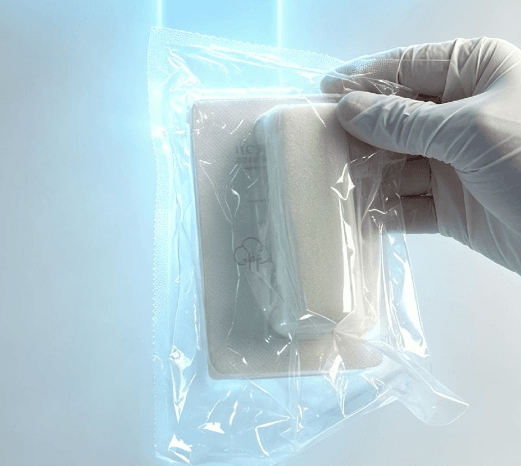
Enhancing Patient Outcomes and Reducing Hospital Operating Room Overhead with a Reliable Absorbable Gelatin Haemostatic Sponge
1. Deciphering the Biochemical Mechanism of Gelatin-Induced Hemostasis in Deep Tissue
Understanding how a surgical hemostatic sponge interacts with the human coagulation cascade is essential for managing diffuse capillary oozing. Unlike mechanical ligatures or electrocautery, which can cause thermal damage to delicate surrounding structures, an advanced absorbable gelatin haemostatic sponge relies on its unique physical matrix to accelerate the body’s natural clotting process.
When the sterile, highly porous gelatin structure comes into direct contact with bleeding tissue, it acts as a mechanical scaffold. The sponge absorbs fluids rapidly, drawing in many times its own weight in blood. This rapid fluid uptake concentrates endogenous platelets and clotting factors directly within the porous channels of the matrix. As platelets fill these microscopic spaces, they undergo rapid aggregation and activation, releasing standard clotting factors that trigger the conversion of fibrinogen to a stable fibrin mesh.
What makes this material highly valuable in complex surgeries is its complete biocompatibility. Over a period of four to six weeks, the material degrades into natural amino acids through standard enzymatic reactions within the body. This safely eliminates the need for a secondary removal procedure, which protects fragile, newly formed tissue layers from mechanical disruption.
2. Specialized Clinical Applications across Neurosurgery and Complex Spinal Procedures
In neurosurgical interventions, maintaining a clear surgical field is a primary priority. Surgeons frequently encounter low-pressure, diffuse bleeding from the cerebral cortex surface or the dura mater where aggressive cauterization is not an option. Placing a tailored absorbable gelatin sponge on these areas provides immediate compression hemostasis without inducing localized inflammation or thermal necrosis.
During spinal fusions or laminectomies, bone surface oozing can obscure critical anatomical landmarks and increase the risk of postoperative epidural hematomas. Operating room teams utilize the sponge to pack vertebral spaces and areas around the spinal hardware. Because the gelatin matrix is exceptionally soft and leaves no fibrous residues or lint behind, it minimizes foreign body reactions in the epidural space.
Traditional cotton patties or non-absorbable packs require manual removal before closure, which introduces a distinct risk of tearing fresh clots or damaging delicate nerve roots. Shifting to a fully absorbable matrix simplifies the surgical workflow, allowing the surgical team to focus entirely on structural stabilization and precise dural repair.
3. Optimizing Outcomes in Oral and Periodontal Surgery After Tooth Extraction
Dental clinics and oral surgery departments frequently manage patients with varied bleeding profiles, including those taking long-term antiplatelet or anticoagulant medications. After a complex tooth extraction or deep periodontal flap procedure, the remaining intraoral wound is highly susceptible to persistent oozing due to constant tongue movement and salivary enzyme interference.
Inserting a pre-cut gelatin sponge for surgery directly into the extraction socket creates a stable mechanical plug that resists salivary breakdown. The material conforms tightly to the irregular bony walls of the alveolus, providing continuous, gentle pressure against the compromised capillaries.
Compared to traditional gauze packing, which requires patients to maintain biting pressure for hours and frequently causes re-bleeding upon removal, the absorbable sponge stays securely in place. It degrades naturally as granulation tissue fills the socket, accelerating the overall healing timeline. This approach significantly reduces the rate of emergency post-extraction visits, minimizing patient anxiety and allowing dental practices to maintain a more predictable daily schedule.
4. Managing Parenchymal Organ Resections in General and Hepatobiliary Surgery
Surgeons managing parenchymal organs like the liver or spleen face a major challenge: controlling diffuse bleeding across large, raw tissue surfaces. When a partial hepatic resection or splenic repair is performed, the raw wound surface often exhibits persistent, low-grade capillary and venous bleeding that sutures alone cannot resolve.
Applying an absorbable gelatin haemostatic sponge across the entire resected surface provides a quick, reliable solution. The material can be applied dry or moistened with sterile saline or a thrombin solution, adapting easily to irregular, raw surfaces.
In hepatobiliary units, minimizing blood loss correlates directly with lower postoperative complication rates and shorter intensive care stays. Using a high-capacity gelatin sponge reduces the need for extensive argon plasma coagulation or extensive suture lines, which can lead to localized tissue ischemia. This localized protection preserves a greater volume of healthy, functional parenchyma and prevents the formation of subcapsular hematomas during the critical early recovery window.
5. A Comparative Analysis of Gelatin-Based Matrices and Traditional Hemostatic Agents
Evaluating surgical consumables requires a careful balance of clinical efficacy and material properties. Traditional oxidized regenerated cellulose (ORC) is widely used, but it generates an acidic local microenvironment that can irritate adjacent nerves and slow down bone regeneration in orthopedic settings.
In contrast, a high-quality absorbable gelatin sponge maintains a neutral pH, ensuring excellent mucosal safety and avoiding chemical irritation in delicate tissue beds. Furthermore, standard microfibrillar collagen hemostats can leave behind fibrous residues that trigger granuloma formation or confuse post-operative imaging results.
The uniform, porous architecture of a modern gelatin sponge ensures it retains its structural integrity while wet, yet handles easily without shedding loose fibers into the wound site. This structural predictability gives surgical teams consistent control during both open and minimally invasive procedures.
| Hemostatic Material | Local pH Impact | Fiber Residue Risk | Removal Required | Primary Clinical Benefit |
| Absorbable Gelatin Sponge | Neutral (Non-irritating) | None / Zero Residue | No (Fully Absorbed) | Preserves nerve and bone tissue integrity |
| Oxidized Cellulose (ORC) | Acidic (Low pH) | Minimal | No | Strong antimicrobial properties in vitro |
| Traditional Microfibrillar Collagen | Neutral | Moderate Risk | No | Rapid platelet aggregation |
| Standard Cotton Packing | Neutral | High Risk | Yes (Manual Removal) | Low initial material cost |
6. Evaluating Procurement Dynamics, Supply Chain Stability, and Hospital Cost Control
For hospital procurement officers and medical device distributors, managing operating room budgets requires sourcing reliable products that do not compromise patient safety. Unplanned surgical bleeding extends anesthesia times, increases blood transfusion costs, and drives up the consumption of expensive secondary sealants.
Integrating a versatile, factory-direct surgical hemostatic sponge into the standard hospital supply chain helps stabilize material overhead. Sourcing directly from an established manufacturer allows healthcare networks to bypass multiple distribution markups and secure competitive pricing for high-volume orders.
Furthermore, because these sponges are available in various standardized sizes, surgical departments can match the exact dimensions to specific procedures. This reduces waste in the operating room, simplifies inventory tracking, reduces sterile storage requirements, and minimizes nursing setup times. Ultimately, choosing a highly adaptable, cost-effective hemostatic solution supports both clinical outcomes and hospital financial sustainability.
📚 References
- World Health Organization (WHO). (2020). Global Guidelines for the Prevention of Surgical Site Infection. Geneva: World Health Organization.
- European Position Paper on Rhinosinusitis and Nasal Polyps (EPOS). (2020). Core Surgical and Postoperative Management Protocols.
- American Academy of Otolaryngology-Head and Neck Surgery (AAO-HNS). (2019). Clinical Practice Guideline: Improving Hemostasis and Patient Recovery Profiles in Outpatient Procedures.
- PubMed Central (PMC). (2022). Enzymatic Degradation Pathways of Gelatin-Based Biomaterials in Parenchymal Organ Interventions: A Systematic Review.