

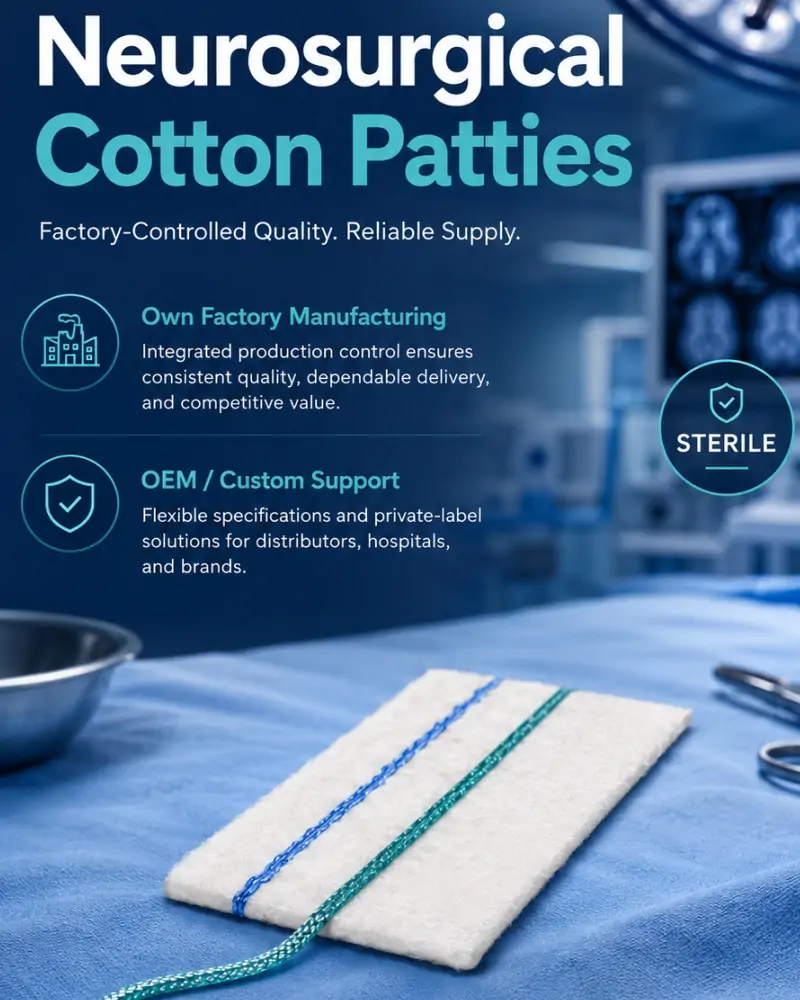
Choosing the right Surgical Patties Supplier is more than comparing quotations. Surgical patties are used in delicate procedures such as neurosurgery, ENT surgery, spine surgery, and microsurgery, where consistent product quality and reliable supply are essential.
Whether you are a medical distributor, hospital procurement manager, or private-label brand owner, selecting the right manufacturing partner can reduce procurement risks, improve customer satisfaction, and support long-term business growth.
This guide explains how experienced buyers evaluate surgical patties suppliers and what questions you should ask before placing an order.
What Are Surgical Patties?
Surgical patties, also known as neurosurgical patties or cottonoids, are small absorbent pads designed for use during surgical procedures. They help absorb fluids, protect delicate tissues, and maintain a clear surgical field.
Depending on the surgical application, suppliers may offer products with:
- X-ray detectable thread
- Blue or green radiopaque markers
- Tail or no-tail designs
- Multiple thicknesses
- Various shapes and sizes
- Sterile or non-sterile packaging (depending on customer requirements)
Not every manufacturer produces the same quality. Material selection, manufacturing consistency, and quality control significantly affect product performance.
Why Choosing the Right Supplier Matters
Unlike many disposable medical products, surgical patties are frequently used near sensitive anatomical structures.
Poor-quality products may lead to:
- Fiber shedding
- Poor absorbency
- Inconsistent dimensions
- Weak radiopaque visibility
- Packaging defects
- Supply interruptions
A reliable supplier helps minimize these risks through standardized production, documented quality systems, and stable manufacturing processes.
Step 1: Confirm the Supplier Is a Manufacturer
Many online suppliers are trading companies rather than actual manufacturers.
Working directly with a manufacturer often provides:
- Better pricing
- Faster technical communication
- Greater customization flexibility
- Better production traceability
- More stable lead times
Ask questions such as:
- Do you own your production facility?
- Can factory audits be arranged?
- Can you provide production photos or videos?
- Who manufactures the product?
For OEM buyers, direct manufacturing capability is especially important.
Step 2: Evaluate Manufacturing Experience
Experience matters because surgical patties require precision manufacturing.
An experienced Neurosurgical Patties Manufacturer should have established procedures for:
- Cotton material inspection
- Cutting accuracy
- Radiopaque thread insertion
- Cleanroom production
- Packaging validation
- Final inspection
Manufacturers serving international markets generally have stronger documentation and quality management systems.
Step 3: Verify Quality Management
Rather than simply asking whether the supplier is “high quality,” ask how quality is controlled.
Important questions include:
| Evaluation Item | Why It Matters |
|---|---|
| Incoming material inspection | Ensures raw material consistency |
| In-process inspection | Detects defects during production |
| Finished product inspection | Verifies dimensions and appearance |
| Batch traceability | Supports recall management if needed |
| Complaint handling process | Indicates quality system maturity |
Reliable suppliers are usually willing to explain their quality procedures rather than simply claiming their products are “the best.”
Step 4: Review Product Customization Capabilities
Many distributors prefer selling their own brands instead of generic products.
An experienced supplier should be able to discuss OEM or private-label options such as:
- Custom product sizes
- Different shapes
- Radiopaque thread colors
- Packaging design
- Private label printing
- Barcode labels
- IFU customization
- Carton artwork
Customization capability often reflects manufacturing flexibility rather than just printing services.
Step 5: Understand Available Sizes
Different surgical specialties require different dimensions.
Typical surgical patties may include:
| Shape | Common Applications |
|---|---|
| Rectangle | General neurosurgery |
| Square | Microsurgery |
| Strip | Deep surgical fields |
| Ribbon | Narrow operative spaces |
| Custom shapes | OEM projects |
Suppliers offering a wider product portfolio can better support distributors serving multiple clinical departments.
Step 6: Ask About Packaging Options
Packaging affects logistics, inventory management, and regulatory compliance.
Common options include:
- Individual sterile pouch
- Double sterile packaging
- Bulk non-sterile packaging
- Hospital pack
- Distributor pack
- Private-label packaging
Packaging requirements often differ between hospitals, distributors, and OEM brands.
Step 7: Evaluate Supply Stability
A supplier offering an attractive price is not necessarily the best long-term partner.
Ask about:
- Monthly production capacity
- Average lead time
- Emergency production capability
- Export experience
- Inventory management
- Production scheduling
Reliable delivery is often more valuable than obtaining the lowest unit price.
Step 8: Compare More Than Price
Many buyers focus only on quotations.
Instead, evaluate the overall value.
| Evaluation Factor | Importance |
|---|---|
| Product consistency | ★★★★★ |
| Manufacturing capability | ★★★★★ |
| Quality documentation | ★★★★★ |
| Delivery reliability | ★★★★★ |
| OEM flexibility | ★★★★☆ |
| Communication efficiency | ★★★★☆ |
| Price | ★★★★☆ |
A slightly higher unit price may reduce overall procurement costs if it results in fewer quality issues and more reliable deliveries.
Step 9: Request Samples Before Large Orders
Most professional buyers evaluate samples before confirming production.
Typical sample evaluation includes:
- Material softness
- Absorbency
- Shape consistency
- Thread attachment
- Radiopaque visibility
- Packaging quality
- Label accuracy
Testing samples helps identify issues before committing to large-volume purchases.
Step 10: Evaluate Communication Quality
Communication often predicts future cooperation.
A professional supplier should respond clearly to questions regarding:
- Product specifications
- Technical documentation
- Packaging options
- Shipping arrangements
- Customization requests
- Production schedules
Slow or unclear communication during the quotation stage may indicate future service challenges.
Common Mistakes Buyers Make
Avoid these common sourcing mistakes:
- Choosing only the lowest-priced quotation
- Ignoring manufacturing capability
- Not requesting samples
- Failing to verify documentation
- Ordering large quantities without trial orders
- Overlooking packaging requirements
- Not discussing customization early in the project
A structured supplier evaluation process helps reduce procurement risks and supports more stable long-term partnerships.
Questions to Ask Before Choosing a Surgical Cottonoid Supplier
Prepare a checklist before requesting quotations.
Recommended questions include:
- Are you the manufacturer or a trading company?
- What product sizes are available?
- Can you support OEM or private-label projects?
- What packaging options do you provide?
- How is product quality inspected?
- Can you provide samples?
- What are your standard production lead times?
- Do you have export experience?
- Can you customize product dimensions?
- How do you ensure batch traceability?
These questions provide a clearer picture of a supplier’s capabilities than price alone.
Frequently Asked Questions
What is the difference between surgical patties and cottonoids?
The terms are often used interchangeably. Cottonoid is a common name for neurosurgical patties used during delicate surgical procedures.
Should I buy directly from a manufacturer?
For distributors and OEM buyers, purchasing directly from a manufacturer generally offers greater customization, pricing transparency, and technical support.
Is OEM available for surgical patties?
Many manufacturers provide OEM and private-label services, including customized packaging, branding, and product configurations.
How important is sample evaluation?
Very important. Sample testing allows buyers to assess absorbency, consistency, packaging quality, and overall workmanship before placing production orders.
Can one supplier provide multiple operating room consumables?
Many manufacturers offer broader portfolios of disposable surgical consumables, allowing buyers to consolidate purchases and simplify supply chain management.
Should I focus only on certifications?
No. Certifications are important, but they should be considered alongside manufacturing capability, quality systems, communication, and delivery performance.
How long should a supplier relationship last?
Many successful distributors build long-term partnerships with manufacturers to ensure product consistency, stable pricing, and predictable supply.
What is the biggest procurement risk?
Selecting a supplier based solely on the lowest quotation without evaluating manufacturing capability or quality management.
Conclusion
Selecting the right Surgical Patties Supplier requires careful evaluation of manufacturing capability, quality management, customization options, packaging flexibility, and supply reliability—not just product price.
For distributors, hospitals, and private-label brands, partnering with an experienced manufacturer can improve procurement efficiency, reduce supply risks, and support long-term business growth. By following a structured supplier evaluation process and requesting samples before large orders, buyers can make more informed sourcing decisions.
If you’re sourcing OEM Surgical Patties or looking for a reliable Neurosurgical Patties Manufacturer, consider working with a supplier that offers transparent quality processes, customization support, and consistent production. You can also explore related Sainsmed product categories such as neurosurgical patties, X-ray detectable gauze, and other disposable surgical consumables to simplify procurement through one manufacturing partner.