
How Shadowless Lamps Work
This article briefly introduces how shadowless lamps work.
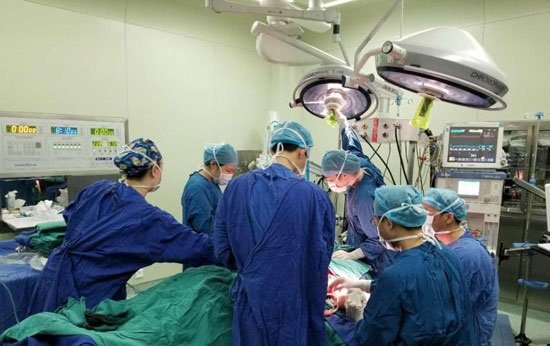
With the advancement of medical standards, operating room configurations have continuously improved. Shadowless lamps are an indispensable piece of equipment in operating rooms; their use provides a brighter surgical field and eliminates, as much as possible, the impact of shadows during surgery.
What is the working principle of shadowless lamps?
First, let's introduce how shadows are formed. Shadows are created when light shines on an object. The scenarios of shadow formation vary, and the effects produced differ in different places. When observing shadows under light, we notice that the center is particularly dark while the edges are slightly lighter. The extremely dark central part is called the "umbra," and the grayish surrounding part is called the "penumbra." These phenomena are closely related to the rectilinear propagation of light. If a cylindrical object is placed on a table with a candle lit beside it, the object will cast clear shadows on both sides.
If two candles are lit beside the object, two overlapping but non-coinciding shadows will form. The area where both shadows overlap receives no light at all and is completely black; this is the umbra. The areas adjacent to the umbra that can be illuminated by only one candle are semi-bright and semi-dark; this is the penumbra. If three or even four candles are lit, the umbra gradually shrinks, and the penumbra develops many layers. The same principle applies to shadows cast by objects under electric light, which consist of both umbra and penumbra. Obviously, the larger the area of the light source, the smaller the umbra. If we light a circle of candles around the aforementioned object, the umbra disappears completely, and the penumbra becomes so faint that it is invisible. Scientists have developed surgical shadowless lamps based on this principle. They arrange high-intensity lamps in a circular pattern on a lamp panel to create a large-area light source. This allows light to illuminate the operating table from different angles, ensuring sufficient brightness for the surgical field while preventing the formation of obvious umbrae, hence the name "shadowless lamp."
What are the components of a shadowless lamp?
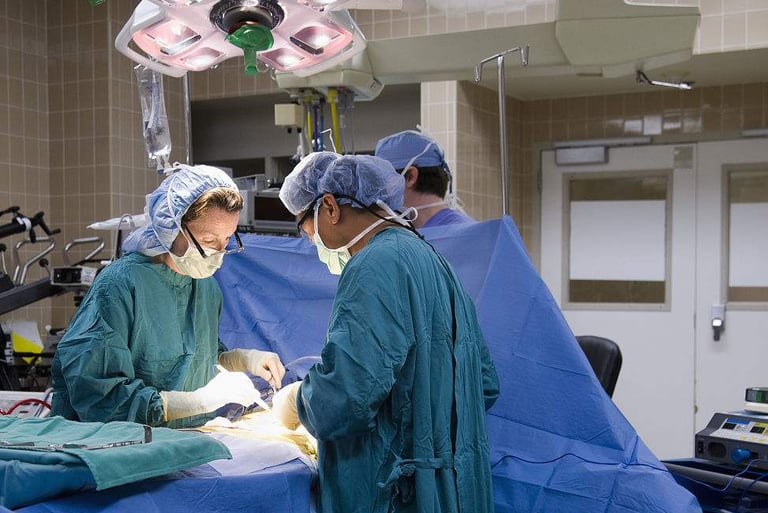
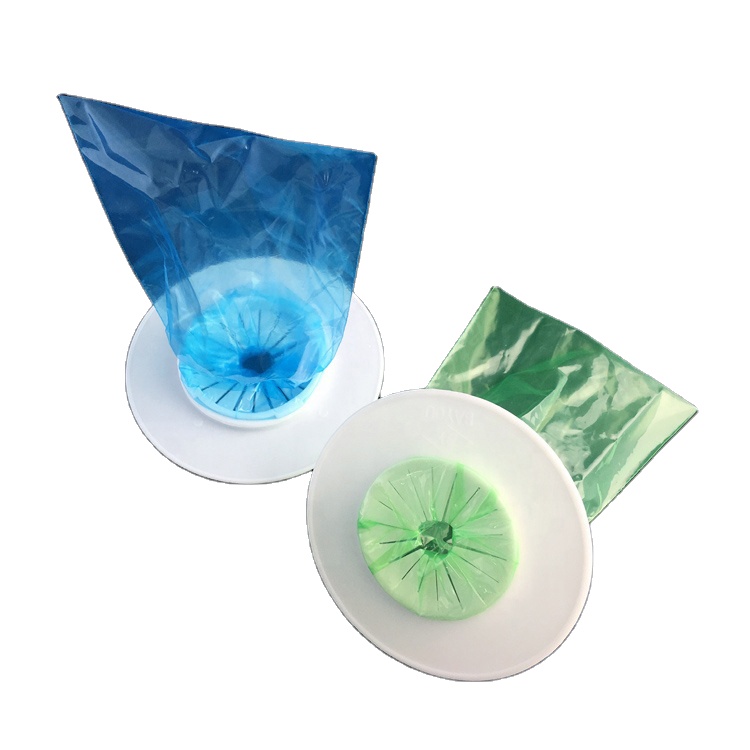
Briefly speaking, a surgical shadowless lamp generally consists of single or multiple lamp heads, with two lamp heads being the most common configuration. The lamp heads are fixed on suspension arms. Doctors can move the lamp vertically or in a circular motion using the handle of the shadowless lamp. The suspension arm is typically connected to a base nearby and can rotate around it. Shadowless lamps use sterilizable handles or sterilizable rings (curved tracks) for flexible positioning and feature automatic braking and stopping functions to control their placement, maintaining appropriate space above and around the surgical site. Additionally, the handles of shadowless lamps can be covered with disposable protective sleeves for sterilization, helping to prevent cross-infection in the operating room.
The mounting device for shadowless lamps can be installed on fixed points on the ceiling or walls, or on ceiling-mounted tracks.
Five Technical Requirements for Shadowless Lamps:
Brightness Requirements
Surgeons must be able to precisely distinguish contours, colors, and movement. Therefore, they require light intensity approaching the quality of daylight. An illuminance of 100,000 lux is equivalent to the brightness of the sun at noon. Furthermore, in the surgical environment, most light is absorbed rather than reflected, which means surgical shadowless lamps must provide even greater brightness. Shadowless lamps can produce a maximum brightness of 150,000 lux, with stepless brightness adjustment available. Only at this level of brightness can surgeons have 50% visible light in the surgical area.Heat-Free Requirements
Bright illumination is often accompanied by heat generation. If heat is produced during surgery, it can pose significant risks to both the surgeon and the patient. Therefore, what is needed during surgical procedures is illumination that provides light without heat.Pathogen-Free Requirements
One of the fundamental elements of surgery is maintaining the lowest possible number of pathogens during the procedure. Generally, shadowless lamp handles require repeated sterilization. After each surgery, the handle is removed and sent to the sterile supply department for disinfection before being reinstalled for use. Alternatively, disposable protective covers for shadowless lamps can be used to prevent pathogen infection.Color Temperature Requirements
Color perception is determined by the color temperature of the ambient light. For example, daylight has a color temperature of 5600 Kelvin; at 5600K, humans perceive the light as white. Therefore, experts recommend that the color temperature of light in operating rooms be at least 4000 Kelvin to produce light similar to therapeutic daylight. Colors are clearest under daylight conditions for the human eye, enabling more accurate diagnoses and preventing eye fatigue for medical staff during long working hours.Shadow-Free Requirements
Through multi-faceted reflectors, shadowless lamps achieve shadow-free illumination. Due to their special shape—composed of numerous reflective surfaces that illuminate the entire surgical area from various angles—many light and shadow patterns overlap to form an absolutely homogeneous light column. Surgery is performed within this light column, which starts 80 cm below the lamp panel and extends deep into the surgical site. Thanks to the perfect design of the reflective surfaces and their large size, this homogeneous light column is not only as bright as daylight but also completely free of shadows. Furthermore, it maintains high uniformity even when parts of the light source are blocked by the surgeon's shoulders, hands, or head.
The above introduces the working principle of shadowless lamps. Our company provides disposable protective covers for shadowless lamps, which save the process of disinfection and sterilization via the supply department, offering convenience to medical staff and reducing their workload.
Contact Information:
+(886)-04-23150236
Sales@sainsmed.com
Office Location:
Jetstar Corporation Limited
Sales@sainsmed.com
22 F.-3, No. 285, Sec. 2, Taiwan Blvd., Minlong Vil., West Dist., Taichung City 403502, Taiwan
Business Hours:
Monday - Friday
9am - 6pm