
Clinical Advantages of Neurosurgical Cottonoids Over Traditional Gauze
Evaluating safety, precision, and intraoperative efficiency in microsurgical neurosurgical practice
1. Structural and Material Superiority
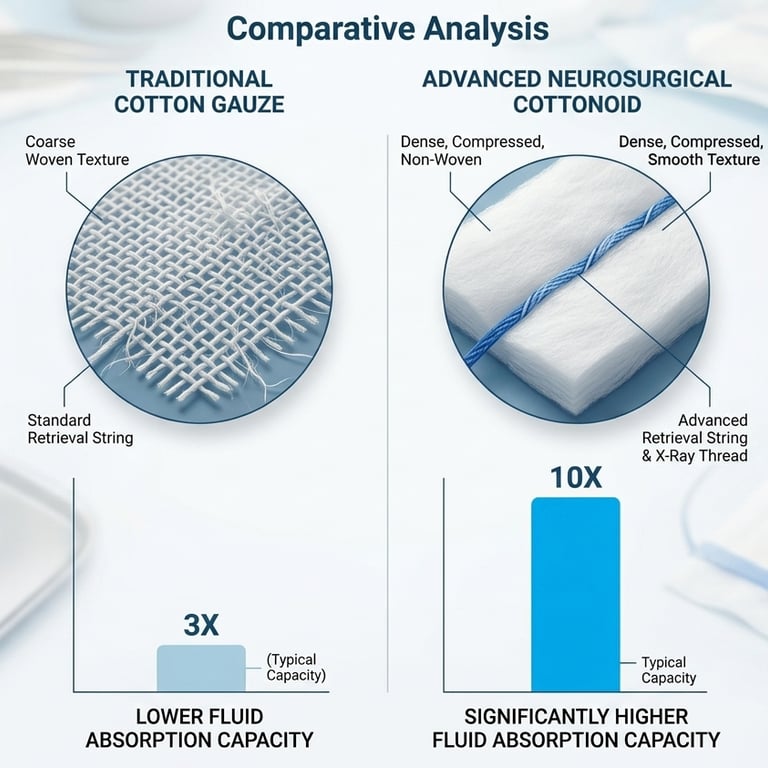
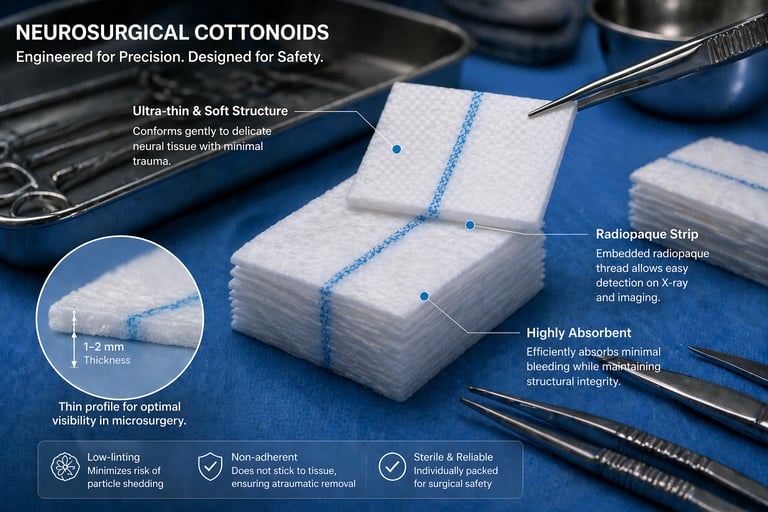
Neurosurgical cottonoids are made from highly purified cotton fibers, processed into thin, soft, and uniform structures. Compared with traditional gauze, they produce minimal lint and reduce the risk of foreign body retention.
Most cottonoids include radiopaque markers, enabling intraoperative and postoperative detection via imaging, significantly enhancing surgical safety.
2. Enhanced Tissue Protection in Microsurgery
In neurosurgery, protecting delicate neural tissue is critical. Cottonoids conform closely to brain surfaces, minimizing mechanical trauma compared to thicker, rough gauze.
They serve as protective barriers and fluid absorbers under the microscope, helping reduce traction-related injury and postoperative neurological deficits.
3. Optimized Fluid Control and Surgical Field Visibility
Cottonoids provide controlled absorption without excessive swelling, maintaining structural stability. This ensures a clear and stable surgical field.
In contrast, traditional gauze may obstruct the operative view due to bulkiness and unpredictable expansion.
4. Improved Safety and Risk Management
Cottonoids support accurate counting and tracking, reducing the risk of retained surgical items (RSIs). Their radiopaque design further enhances detectability.
Low linting properties also reduce inflammatory responses and granuloma formation, which is especially important in central nervous system procedures.
5. Specialized Clinical Adaptability
Cottonoids are widely used in brain tumor resections, aneurysm surgeries, and spinal procedures. Their availability in various sizes and configurations allows precise adaptation to specific surgical needs.
This level of specialization significantly improves surgical efficiency and precision compared to general-purpose gauze.
Conclusion
Neurosurgical cottonoids demonstrate clear advantages over traditional gauze in terms of precision, safety, tissue protection, and intraoperative management. As neurosurgery continues to evolve toward minimally invasive and high-precision techniques, cottonoids have become an essential standard rather than an optional alternative.
Their adoption contributes to improved surgical outcomes, reduced complications, and enhanced patient safety.
Office Location:
Medmoist Inc Corporation
1500 N GRANT ST, STE R, DENVER, CO 80203, US
Branch Offices:
22 F.-3, No. 285, Sec. 2, Taiwan Blvd., Minlong Vil., West Dist., Taichung City 403502, Taiwan
Contact Information:
Sales@sainsmed.com
Copyright © 2026 Sainsmed. All Rights Reserved. Sainsmed is a brand owned and operated by Medmoist Inc.