

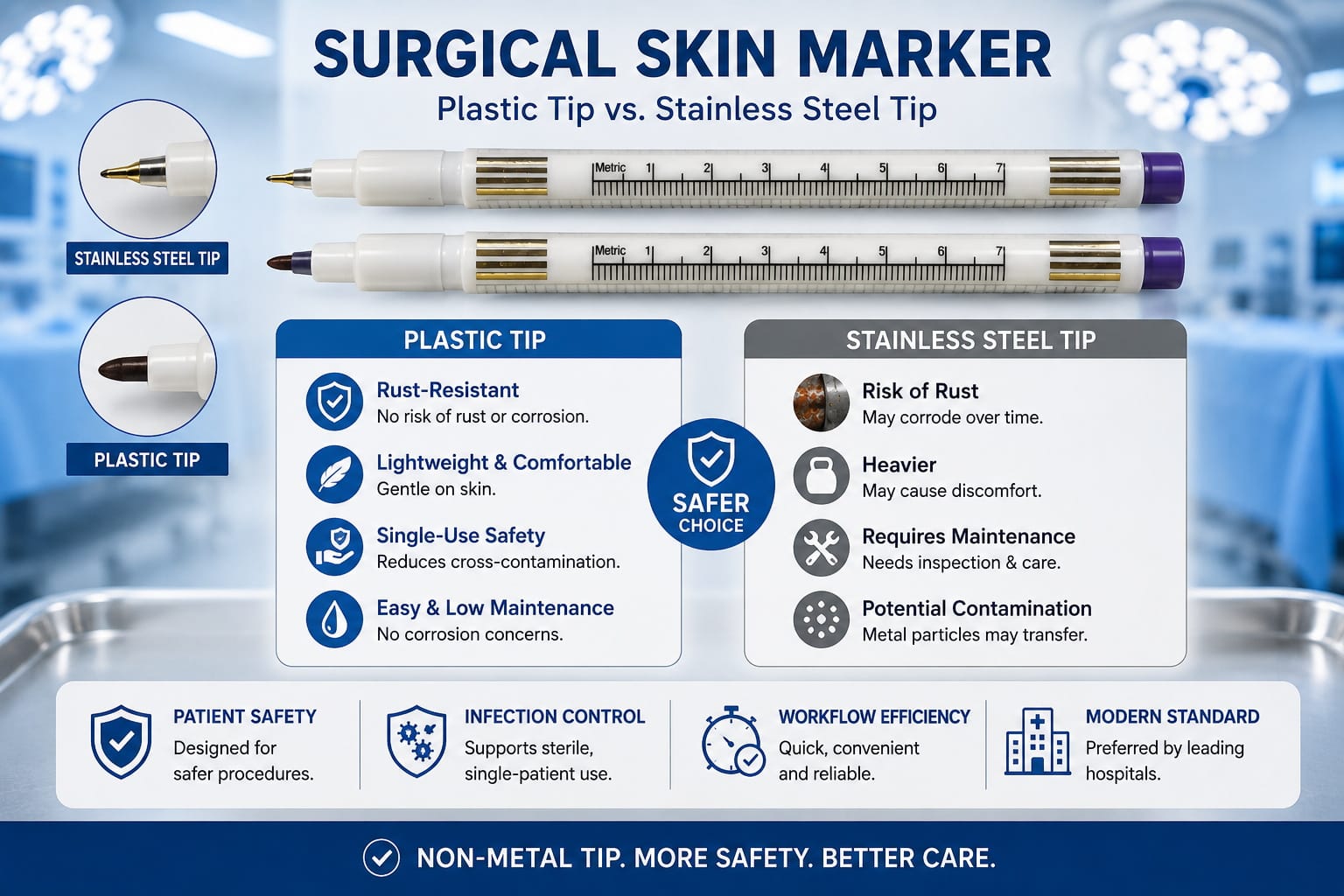
A clinical and material-based analysis of surgical skin marker tip designs in modern healthcare environments.
Introduction
Surgical skin markers are widely used in operating rooms, outpatient surgery centers, and preoperative preparation areas for surgical site identification and procedural guidance. In modern healthcare environments, hospitals increasingly focus on product stability, infection-control compatibility, patient comfort, and workflow efficiency when selecting surgical marking systems.
Among current surgical skin marker designs, plastic tips and stainless-steel tips are the two most common structures. Although both can achieve effective marking performance, their material characteristics, long-term stability, and maintenance considerations differ significantly.
1. Material Characteristics of Plastic Tips and Stainless-Steel Tips
Plastic-tip surgical markers are typically manufactured using medical-grade polymer or fiber materials. These materials are lightweight, chemically stable, and resistant to oxidation. Their softer structure also allows smoother contact with uneven skin surfaces, improving comfort during preoperative marking.
Stainless-steel tips provide higher rigidity and a firmer writing feel. However, stainless steel remains a metallic material that may still be affected by humidity, surface scratches, chemical exposure, or storage conditions over time. According to guidance published by STERIS, stainless steel is “stain resistant, not stain proof,” meaning oxidation and corrosion may still occur under certain environmental conditions.
Unlike metallic structures, plastic-tip designs contain no exposed metal components, allowing them to avoid oxidation-related concerns entirely.
2. Advantages of Plastic-Tip Surgical Markers
One of the most important advantages of plastic-tip surgical markers is their corrosion-free structure. Plastic materials do not rust and are not affected by environmental moisture in the same way metallic surfaces may be.
This characteristic aligns well with modern hospital preferences for stable, low-maintenance medical products. Plastic-tip designs also avoid concerns related to metallic discoloration, oxidation, or surface degradation.
Another important benefit is improved handling comfort. Plastic tips are generally softer and more flexible, allowing smoother skin contact during surgical site marking. This can be especially beneficial in sensitive anatomical areas or pediatric applications.
Plastic-tip structures are also highly compatible with modern infection-prevention workflows because their non-metal design simplifies material management and reduces concerns regarding metallic surface conditions over time.
Currently, many major medical manufacturers in Europe and the United States use non-metal plastic or fiber-tip designs in their surgical marker product lines. These products are widely used in operating room environments and emphasize stable marking performance, infection-control compatibility, and efficient clinical workflow integration.
3. Limitations of Stainless-Steel Tip Designs
Although stainless-steel tips provide structural rigidity and may create finer marking lines in some applications, they also present several practical limitations.
First, metallic tips inherently carry oxidation risk. While medical-grade stainless steel offers good corrosion resistance, it is not completely immune to environmental degradation. Exposure to humidity, chemical agents, packaging environments, or transportation conditions may gradually affect metallic surfaces.
The British Stainless Steel Association (BSSA) notes that chloride-containing environments and improper handling may contribute to stainless steel corrosion in medical applications.
BSSA Surgical Stainless Steel Guidance
Second, metallic structures generally require additional surface finishing and manufacturing control compared with plastic-tip designs. For healthcare facilities focused on workflow efficiency and simplified product management, non-metal structures may offer operational advantages.
Additionally, stainless-steel tips are usually harder and less flexible than plastic tips, which may reduce comfort during prolonged or detailed marking procedures.
4. European and American Hospital Usage Trends
Modern operating room practices in Europe and North America increasingly emphasize:
- Product stability
- Infection-control compatibility
- Lightweight device handling
- Simplified workflow management
- Consistent marking performance
As a result, non-metal plastic/fiber-tip surgical markers have become increasingly common across many healthcare systems.
The AORN Correct Site Surgery Guidelines emphasize proper surgical site marking and infection-prevention practices. Although the guidelines do not specifically mandate plastic-tip structures, many commercially adopted operating room skin markers used in U.S. hospitals today utilize non-metal tip designs.
Similarly, NHS procurement systems in the United Kingdom commonly adopt fiber-tip surgical markers designed to support stable clinical performance and infection-control compliance.
This trend reflects a broader market preference toward:
- Non-metal structures
- Corrosion-free materials
- Simplified maintenance
- Lightweight handling
- Stable clinical performance
5. Conclusion
Both plastic-tip and stainless-steel-tip surgical markers can provide effective surgical site marking performance. However, from the perspectives of corrosion resistance, material stability, patient comfort, workflow efficiency, and maintenance simplicity, plastic-tip designs offer several important advantages in modern healthcare environments.
Because plastic-tip markers eliminate exposed metallic structures, they avoid oxidation-related concerns while also providing lighter handling and smoother skin contact. For these reasons, non-metal plastic-tip surgical markers are increasingly becoming the preferred choice across many European and American healthcare systems.